

When the Fédération Internationale de Football Association (FIFA) unveiled the location of the 2026 World Cup, sports fans across North America naturally rejoiced. For the first time, the most-watched tournament in the world would be hosted by three countries: Mexico, the US and Canada. And this time, advocates had a reason to be enthusiastic, too—FIFA would require host nations and cities to submit a human rights plan as part of its selection criteria. This new policy signaled FIFA’s commitment to creating the infrastructure to address human rights abuses and to protect workers, following the highly-publicized, atrocious working conditions faced by guestworkers in the years leading up to the Qatar 2022 World Cup.
Continue reading “Open Letter to FIFA”Statement on “The Biden Administration Blueprint for a Fair, Orderly, and Humane Immigration System” and “Collaborative Migration Management Strategy” report
Last week, the Biden Administration published its Blueprint for a Fair, Orderly, and Humane Immigration System and the “Collaborative Migration Management Strategy” report, both of which included plans to expand access to Central America for the current H-2A and H-2B temporary work visa programs. At the same time, the Administration announced that it will resume the inhumane expedited removal of asylum-seeking families, and has yet to repeal the Title 42 policy, which directs immigration authorities to summarily expel migrants without providing them the opportunity to seek protection in the United States. These policies are a troubling continuation of the Trump Administration’s approach, prioritizing the expansion of exploitative temporary work visa programs over our government’s humanitarian responsibilities to asylum seekers and those with protection needs.
Continue reading “Statement on “The Biden Administration Blueprint for a Fair, Orderly, and Humane Immigration System” and “Collaborative Migration Management Strategy” report”Letter of Opposition to Harmful H-2 Appropriation Riders

We fear that the appropriations process will once again be used to the
detriment of workers, whose risks have only intensified during the Covid-19 pandemic. In this letter, we strongly urge members of Congress to oppose any and all appropriation riders that will increase exploitation and further undermine fundamental rights for migrant workers and workers in the U.S.
Statement on President Biden’s Immigration Plan
January 22, 2021
Migration that Works applauds the Biden-Harris administration for its bold immigration plan that would grant a pathway to citizenship to millions of undocumented individuals, including DACA recipients, TPS holders, and immigrant farmworkers. We also celebrate the end of the Muslim travel ban and a commitment to advance racial equity signaled through Day 1 executive orders.
Since 2011, Migration that Works has advocated for strong worker protections in the U.S. temporary work visa programs, including the H-2A, H-2B, H-1B, J-1, and TN visa categories. Many of those workers, sadly, find themselves in abusive worksites where their labor and employment rights are not respected and are repeatedly violated with impunity by employers that can exert a great deal of power over them due to the legal frameworks of work visa programs, most of which tie each worker and their immigration status to a single employer. Last month, our coalition met with the Biden-Harris Transition team, sharing our recommendations to advance policies and a labor migration model that respects and uplifts the experiences of hundreds of thousands of migrant workers who enter the U.S. every year. We are happy to see the Biden-Harris immigration plan include protections from retaliation for workers that would allow them to remain in the country to pursue legal avenues to seek redress and hold employers accountable for lawbreaking.
Our coalition looks forward to working with the Biden-Harris Administration to ensure strong, enforceable protections are in place for the migrant and seasonal workers in the temporary work visa programs, to ensure that temporary work status is de-linked from employers, and to ensure the fair treatment and dignity of all workers, regardless of status.
Migration that Works is a coalition of labor, migration, civil rights, anti-trafficking organizations and academics advancing a labor migration model that respects the human rights of workers, families and communities and reflects their voices and experiences. We envision a value-based model for labor migration that prioritizes the human rights of workers and their families, elevating labor standards for all workers.
The Biden-Harris Administration Should Ensure Protections for Migrant Workers
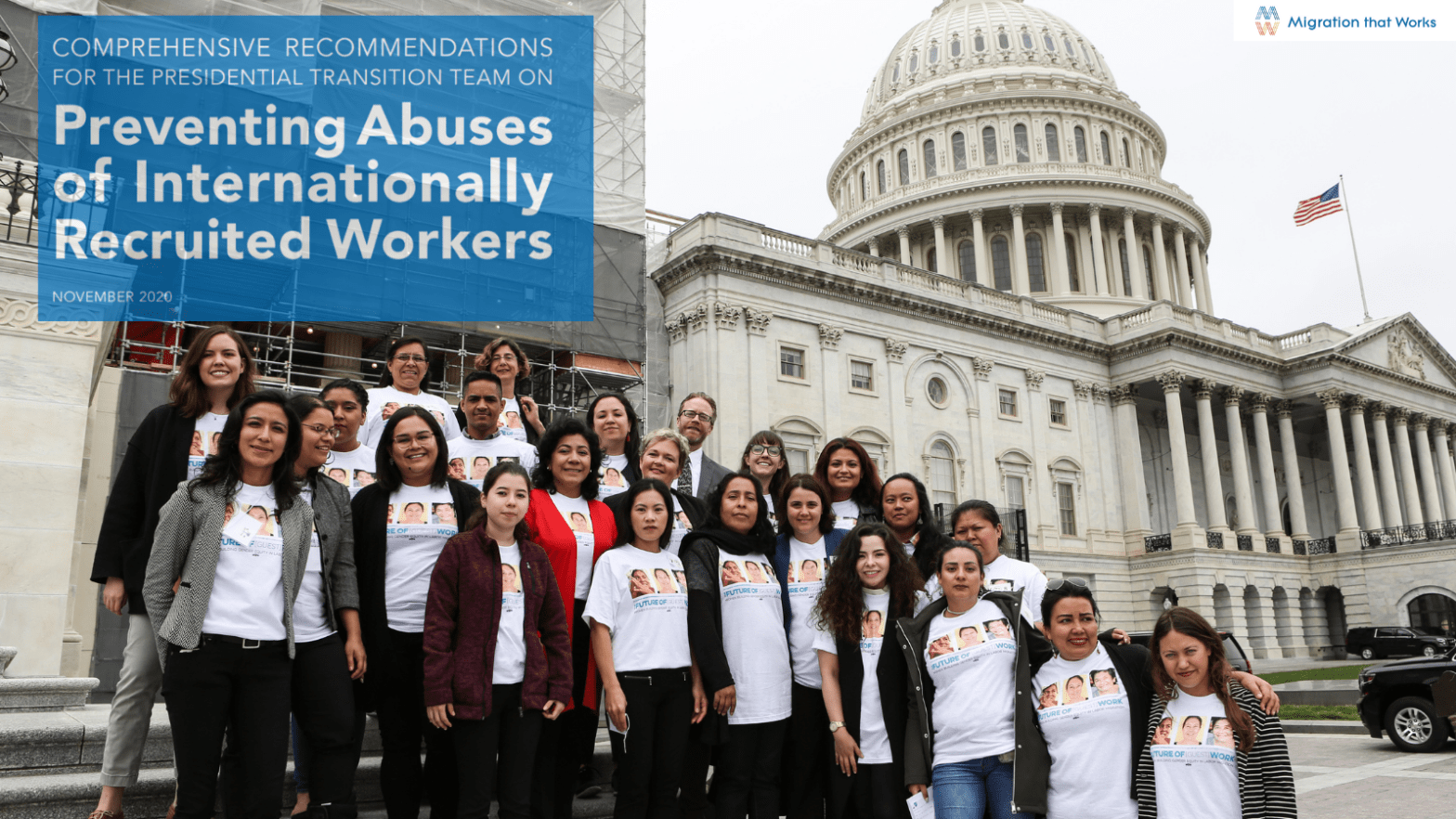
As the COVID-19 pandemic worsens across the country and millions of families remain at home to keep safe, essential workers continue to risk their lives in every sector of the economy. Despite their sacrifice, workers on the front lines have often been denied basic protections. In one particularly stark example, Maribel and Reyna, two crawfish workers in Louisiana, watched as dozens of their coworkers fell sick with COVID-19. Despite the outbreak, their employers failed to provide them with masks and instead forced them to continue working and living in crowded, dangerous conditions. When two workers became sick and sought medical attention, their employer fired them and reported them to immigration authorities.
For migrant workers, labor abuse didn’t start with the COVID-19 crisis. Rather, the pandemic has laid bare the ways in which our country’s temporary visa programs systematically risk the lives of hundreds of thousands of migrant workers who come to the United States every year. Workers are often recruited from their home countries with false promises. Instead, many discover hazardous working conditions, deplorable housing, and stolen wages. They are often unable to quit or return home because they are indebted to recruiters who charged them illegal fees in exchange for the promise of employment. Their visas and work authorization tie them to their employers, making it virtually impossible for them to find alternative employment. And with little government oversight or enforcement, unscrupulous employers are able to continue profiting from this exploitation.
As the country reckons with the havoc wrought by the pandemic, the economic crisis, and four years of harmful government action, it must prioritize the needs of its most vulnerable workers.
Migration that Works, a coalition of labor, migration, civil rights, anti-trafficking organizations and academics, has outlined how the new Biden-Harris administration can chart a new way forward in its transition plan, Comprehensive Recommendations for the Presidential Transition Team on Preventing Abuses of Internationally Recruited Workers.
The MTW transition plan provides detailed recommendations for the Departments of Labor, Homeland Security, State, and Justice as well as the National Labor Relations Board and the Equal Employment Opportunity Commission. We call on the Biden-Harris administration to:
- Implement realistic, worker-protective policies and practices to end recruiter fees. Recruiters–not workers–should face consequences when illegal fees are charged.
- Provide immigration relief and work authorization for whistleblowers. Labor laws can only be effectively enforced when workers know that they will not face retaliation for reporting workplace mistreatment.
- Revive the interagency task force on international labor recruitment.
- Improve the transparency of temporary work visas by creating an accessible website with detailed information about visas, jobs, and recruiters.
- Overhaul the visa programs so that each visa category has consistent regulations under a single framework.
- Create an Office of International Labor Recruitment Certification and Oversight with the power to block program violators from accessing future visas.
- Improve employer accountability by requiring all who benefit from migrant labor agree to joint liability.
- Improve worker education and access to information by cooperating with governments in countries of origin to thwart misleading propaganda and by enhancing information provided during consular processing of temporary work visas.
- Increase resources for enforcement so that unscrupulous employers and recruiters cannot continue profiting off of the mistreatment of migrant workers.
- Expand labor and employment protections for migrant workers, particularly during the pandemic.
These changes alone are only the beginning.
These changes alone are only the beginning. Legislative reforms— to end the current system of tied visas and including a pathway to citizenship for all temporary work visa holders—are also necessary. The Biden-Harris administration must reform our labor migration system to ensure all workers are treated with dignity and respect.
Migration that Works would like to thank Georgetown University Law Center Federal Legislation Clinic Director Cori Alonso-Yoder and students Jocelyn Westray and Marquisha Johns for contributing to this transition plan.
Click here to read our Transition Memo.

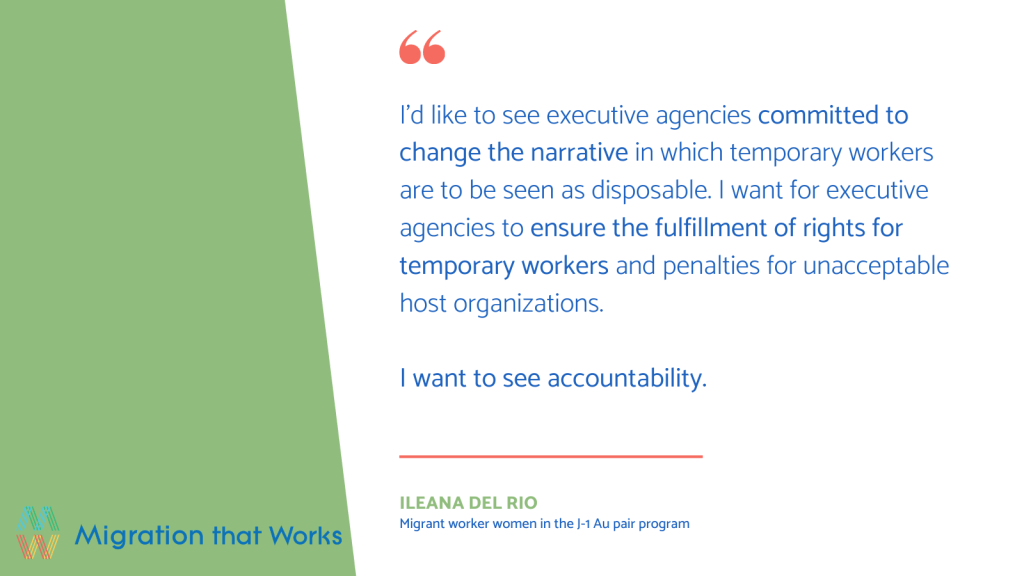

Social media toolkit about transition memo: here.
USDA’s Cancellation of Farm Labor Survey will Result in Massive Wage Cuts
On September 30, the U.S. Department of Agriculture (USDA) issued a notice cancelling the Farm Labor Survey (FLS) of agricultural employers. The FLS is one of the best sources of information on the wages of agricultural workers—and the Department of Labor (DOL) is required to use it to determine what is known as the Adverse Effect Wage Rate (AEWR), the main minimum wage that employers must pay to farmworkers employed through the H-2A agricultural guestworker program, as well as similarly situated U.S. workers. In the absence of FLS results, DOL will lack the necessary information to adequately set the AEWR for 2021 and beyond. This will result in massive wage cuts for both U.S. farmworkers and farmworkers recruited and employed through the H-2A program. Consequently, a reduction in H-2A guestworker wages risks expansion of the structural and systemic conditions for labor trafficking in U.S.agriculture. Wage cuts may increase the financial burden of migrant guestworkers, many of whom are particularly vulnerable to debt bondage, a nonviolent method of coercion in labor trafficking.
Throughout the years we have seen a rapid expansion of the H-2A program. Over 250,000 H-2A jobs were certified in FY 2019 and the program is on track to surpass that in FY 2020.
Rather than giving the farmworkers the Trump administration has deemed “essential” a raise in 2021, Trump has opted to give them a pay cut instead, while giving yet another subsidy to the farm industry in the form of lower labor costs—on top of the $32 billion in federal subsidies the industry has already received in 2020—and during a year in which farm employers increased their net income by 23%.
The Immigration and Nationality Act (INA) for decades has prohibited employers from hiring guestworkers at wage rates that would “adversely affect” the wages and working conditions of U.S. farmworkers, which is implemented through the AEWR. This is an important protection for both domestic farmworkers and migrant guestworkers that helps keep farm employers from manipulating the immigration system in order to cut labor costs and degrade standards for all.
Migration that Works objects to this sudden and abrupt cancellation of the FLS and sees this action from the Trump Administration as creating an incentive to exploit an already-vulnerable workforce. The H-2A program is rife with abuse, ranging from wage theft to labor trafficking. In a survey done among H-2A workers, only 43% of the respondents indicated that they had been paid all of the wages they were owed. This action from the Trump administration signals a move towards further weakening the very few labor protections available to farmworkers. It will have a significant impact on farmworkers’ income, which is already precarious, and make them even more vulnerable to economic insecurity and labor trafficking.
Migration that Works is a coalition of labor, migration, civil rights, and anti-trafficking organizations and academics working to address abuses in international labor recruitment.
Throughout the years we have seen a rapid expansion of the H-2A program. Over 250,000 H-2A jobs were certified in FY 2019 and the program is on track to surpass that in FY 2020.
Rather than giving the farmworkers the Trump administration has deemed “essential” a raise in 2021, Trump has opted to give them a pay cut instead, while giving yet another subsidy to the farm industry in the form of lower labor costs—on top of the $32 billion in federal subsidies the industry has already received in 2020—and during a year in which farm employers increased their net income by 23%.
The Immigration and Nationality Act (INA) for decades has prohibited employers from hiring guestworkers at wage rates that would “adversely affect” the wages and working conditions of U.S. farmworkers, which is implemented through the AEWR. This is an important protection for both domestic farmworkers and migrant guestworkers that helps keep farm employers from manipulating the immigration system in order to cut labor costs and degrade standards for all.
Migration that Works objects to this sudden and abrupt cancellation of the FLS and sees this action from the Trump Administration as creating an incentive to exploit an already-vulnerable workforce. The H-2A program is rife with abuse, ranging from wage theft to labor trafficking. In a survey done among H-2A workers, only 43% of the respondents indicated that they had been paid all of the wages they were owed. This action from the Trump administration signals a move towards further weakening the very few labor protections available to farmworkers. It will have a significant impact on farmworkers’ income, which is already precarious, and make them even more vulnerable to economic insecurity and labor trafficking.
Migration that Works is a coalition of labor, migration, civil rights, and anti-trafficking organizations and academics working to address abuses in international labor recruitment.
The Senate must protect migrant workers during the pandemic
Today, we are writing to the U.S. Senate urging policymakers to protect the more than one and a half million workers employed in the United States through temporary foreign work visas in any future legislation related to the impacts of the COVID-19 pandemic.
Instead of enhancing desperately needed protections for temporary foreign workers during the COVID-19 pandemic, recent actions by the administration threaten to increase their exploitation and vulnerability to trafficking. As the Senate considers additional legislation to respond to the COVID-19 pandemic and its economic impacts, we are seeking for specific measures to be included to protect the health, safety, and economic security of these essential workers.
Read our full letter to the Senate here and download below.
Our letter regarding the latest temporary rule changes to the H-2 programs
Last week, we wrote to the U.S. Department of State, Labor, and Homeland Security to express our concern regarding the implications of recent temporary rule changes to the H-2A and H-2B (“H-2”) visa programs. Although these rules intend to protect the U.S. food supply chain, we believe that – without clarification and modifications – they threaten to increase the exploitation and vulnerability to trafficking for the temporary guestworkers critical to the continued operation of this country’s food supply chain.
Read the full letter here or download below.
2020 TRAFFICKING IN PERSONS REPORT FAILS TO RECOGNIZE EXTENT OF WIDESPREAD ABUSES IN U.S. GUESTWORKER PROGRAMS

2020 TRAFFICKING IN PERSONS REPORT FAILS TO RECOGNIZE EXTENT OF WIDESPREAD ABUSES IN U.S. GUESTWORKER PROGRAMS
On June 16, the U.S. Department of State released its 20th annual Trafficking in Persons Report. Migration that Works, a coalition of labor, migration, civil rights, anti-trafficking organizations and academics advancing a labor migration model that respects the human rights of workers, families and communities – issued the following statement in response:
We are disappointed to see that the U.S. has once again given itself a top grade when it comes to efforts to fight human trafficking. As a diverse coalition of advocates and service providers working directly with survivors of human trafficking in multiple sectors of the labor force, we know firsthand that this grade has not been earned. In particular, we believe the U.S. has a tremendous amount of work to do to address vulnerability to labor trafficking in its guestworker programs.
Rachel Micah-Jones, executive director of Centro de los Derechos del Migrante (CDM) which chairs Migration that Works, said she and her staff were surprised to see that the U.S. maintained its Tier 1 ranking in the TIP report. “The U.S. should have been downgraded. As an organization that supports migrant worker advocacy, CDM has filed two trafficking lawsuits with internationally recruited workers in the last week alone.”
Two hallmarks of these programs, worker indebtedness through the recruitment process and unbreakable ties to a specific employer, virtually guarantee that workers cannot safely speak out against abuse for fear of deportation. U.S. government asylum policies, mass detention of immigrants in recent years, including separation of families, and immigration policy response to COVID-19 have exacerbated immigrant workers’ vulnerability and created a climate of fear that fundamentally erodes U.S. efforts to address human trafficking.
Although the TIP report is used primarily as a tool of diplomacy to “name and shame” countries into improving trafficking prevention and response efforts, the report nonetheless serves as an indicator about how seriously the U.S. takes trafficking in its own backyard. By giving itself a Tier 1 rating, the U.S. government continues to demonstrate apathy toward meaningful improvements of conditions for immigrant workers who provide essential contributions to the U.S. economy. We believe that to truly earn a Tier 1 rating, the U.S. must reimagine its guestworker programs so they uphold fundamental rights to freedom of movement, freedom from economic coercion and intimidation, and access to justice.
###
Migration that Works is a coalition of labor, migration, civil rights, anti-trafficking organizations and academics advancing a labor migration model that respects the human rights of workers, families and communities and reflects their voices and experiences. We envision a value-based model for labor migration that prioritizes the human rights of workers and their families, elevating labor standards for all workers.
Statement on Trump Administration Executive Order Restricting Worker Visas
Migration that Works, a coalition of labor, academics, migrant rights and anti-human trafficking organizations formed in 2011, denounces the Administration’s latest immigration order as another tactic to divert attention from its dismal response to the COVID-19 crisis, which has left more than 120,000 people in the U.S. dead. Instead of focusing on taking concrete actions to protect all workers, this Administration relies, once again, upon furthering a nativist agenda in an effort to divide workers.
We are seeing a rising number of workers dying and being infected with coronavirus on the job. Thousands of workers are falling ill to the coronavirus in unsafe and dangerous work sites throughout the country. These workers are not provided with personal protective equipment; paid sick leave; and, they face retaliatory action if they raise a complaint about their work conditions. Yet, there is no action from the agency that is supposed to be workers’ health and safety watchdog – OSHA.
Missing in this order is anything that reforms the problematic guestworker programs. International workers experience abusive recruitment processes in which they are often charged exorbitant amounts of money. This Order does not indicate what steps the Administration will take to address workers that have already incurred significant expenses in pursuing guestworker visas. Applicants often take out loans or put property up for collateral in order to pay several thousand dollars in fees in order to secure a visa. This is a long process that with this announcement leaves them in the dark. Unknown is whether the recruiters and sponsor agencies involved will reimburse these workers for unused fees.
Instead of nativist and xenophobic bans, we need protections for all workers now.
 migrationthatworks.org